
Why Photochemical Etching is the Trusted Process for Instrumentation Parts Manufacturers
Test and measurement (T&M) instruments are only as accurate as the components inside them. Engineers designing for metrology, calibration, and inspection rely on thin-metal parts such as grids, shims, apertures, and encoder disks, all of which must deliver repeatable results under exacting conditions.
For these critical applications, photochemical etching has long been a trusted process, offering a proven path to micron-level precision, burr-free edges, and stress-free geometry, without the thermal or mechanical distortion introduced by other fabrication methods.
At FotoFab, we specialize in delivering chemically etched components for the T&M industry. With deep engineering expertise in ultra-precise thin-metal parts and long-standing experience supporting world-class T&M manufacturers, we produce components with the repeatability required for calibration-critical tools. Our precision photo etching process ensures the accuracy, consistency, and reliability that test and measurement devices demand across optical, mechanical, and electronic systems.
This article explores how photochemical etching enhances the accuracy and efficiency of key Test & Measurement components, highlighting the benefits of burr-free, flat, and stress-free parts in calibration-critical systems and explaining why etched components enable systems to measure with greater precision while reducing variability and operator error.
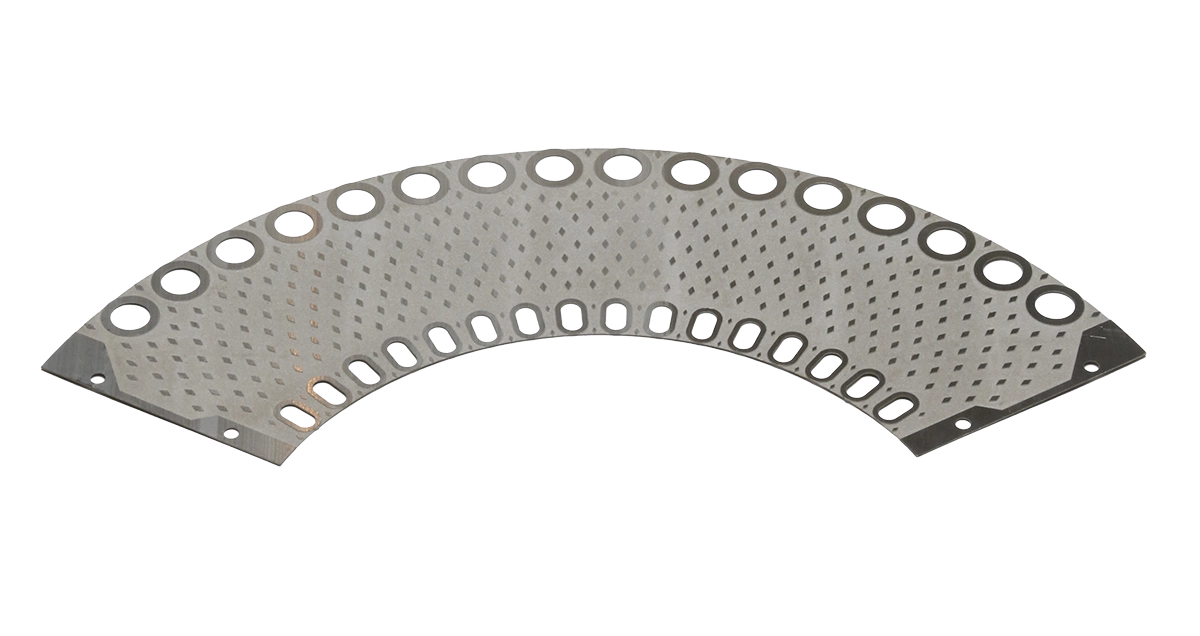
The Role of Precision Metal Components in Measurement Systems
Test and measurement equipment spans many disciplines: optical inspection systems, spectrometers, calibration tools, oscilloscopes, high-resolution encoders, and more. Right across these diverse platforms, etched metal parts play essential roles in controlling light paths, regulating electronic signals, and maintaining mechanical accuracy.
These components include:
- Optical measurement systems (apertures, filters, precision slits)
- Calibration tools (reference masks, etched grids)
- Imaging and inspection equipment (alignment frames, stencils)
- Electronic signal analysis systems (shields, shims, encoder disks)
Each of these components requires tight tolerances, smooth edges, and stable geometry to prevent signal loss, distortion, or calibration drift.
Precision Grids: Improving Signal Clarity and Alignment
Grids are used in optical, imaging, and electromagnetic measurement systems to align beams, mask areas, or filter signals. Even the smallest imperfection, like a burr, taper, or inconsistent spacing, can degrade the system’s signal-to-noise ratio or introduce artifacts.
Photo etching solves this by eliminating thermal or mechanical stress while maintaining burr-free results, uniformity, and repeatability. Engineers can specify exact grid sizes, bar widths, and open-area percentages to match optical or electronic performance requirements.
These precision etched grids are commonly used in:
- Optical calibration devices where visual accuracy is critical
- Static testing systems for light modulation
- X-ray and radiation detection where edge uniformity impacts output channels
Static Testing: Built for Stability and Impact Resistance
In static testing environments, precision components must deliver consistent performance under tightly controlled conditions. Whether measuring light modulation, radiation intensity, or mechanical force, etched metal parts offer the dimensional accuracy and impact resistance needed for reliable results. Fotofab supports a full line of static testing applications with custom-manufactured grids, masks, and apertures, ensuring repeatable performance where accuracy is non-negotiable.
Apertures: Controlling Light, Signals, and Measurement Accuracy
Apertures shape and regulate light in imaging, spectroscopy, and laser-based measurement tools. Any deviation in shape or diameter can skew results or limit resolution. The clean edges and accurate geometries provided by chemical etching eliminate the edge roughness that can scatter light or distort beams.
Precision etched apertures offer a number of key benefits that include:
- Consistent beam shaping in laser alignment systems
- Improved accuracy in optical encoders
- Controlled exposure in inspection and metrology equipment
By tightly controlling material thickness, shape, and size, etched apertures help achieve repeatable results across optical and electronic test environments.
Shims & Spacers: Maintaining Calibration Consistency
In mechanical and electronic measurement systems, shims and spacers play a deceptively important role. They fine-tune alignment, define precise offsets, and help maintain positional consistency over time.
If these components are warped, stressed, or improperly spaced, calibration errors and drift can occur. Photo etched shims are flat, distortion-free, and can be produced in complex shapes with tight thickness tolerances, perfect for:
- Laser interferometry and optical benches
- Precision assembly jigs and inspection fixtures
- Electronic controller alignment for reduced operator error
Compared to machined shims, etched parts eliminate residual stress and minimize downtime caused by misalignment or component wear.
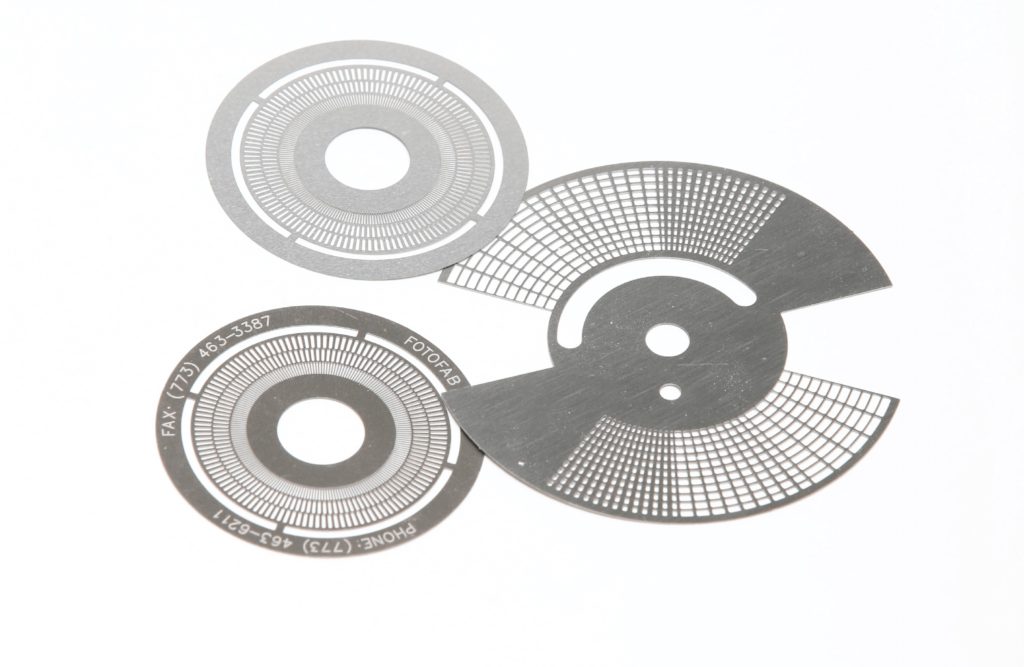
Optical Encoders: Accurate Motion and Position Measurement
Encoder disks are critical in rotary and linear measurement systems. Whether optical or magnetic, their precision determines system resolution and measurement fidelity.
The tight feature spacing, uniformity, and stress-free structure provided by photochemical etching are ideal for encoder disk manufacturing. Etched encoder disks reduce the risk of controller error and offer superior performance over alternatives cut by laser or die-punching methods.
FotoFab’s precision etching process ensures:
- Long-term reliability even in high-speed or harsh environments
- High accuracy in optical encoder lines or patterns
- Reliable performance in industrial and power generation equipment

Why Photochemical Etching Outperforms Other Methods
In T&M, tight tolerances directly define performance. Even minimal stress, warping, or inconsistency alters how light, force, or signal moves through a system, compromising accuracy and the data behind it. Etching gives engineers unmatched control over design, dimensions, and performance.
Here’s how it compares to traditional machining methods:
| Feature | Photochemical Etching | Laser Cutting | CNC Machining |
| Heat-Affected Zones | None | Present (can warp thin sheet) and leave slag | Minimal (but slower process) |
| Edge Quality | Burr-free, smooth | Possible taper, heat-affected | Tool marks, possible burrs |
| Complex Features | Excellent (high-resolution masks) | Limited by laser beam diameter and can add can add cost | Limited by tool geometry and can be costly |
| Material Stress | None | High localized stress | Can induce stress |
| Iteration Speed | Very High (no hard tooling) | Medium | Low (high setup time) |
| Tooling Costs | Low | Medium to High Can be very costly | High |
Whether you’re designing a new product line or refining a legacy device, chemical etching gives you the freedom to create high-precision components with minimal cost and risk.
How FotoFab Supports Test, Power Generation & Measurement OEMs
With over 50 years of experience, FotoFab is a trusted partner for engineers designing and manufacturing precision components in test and measurement environments.
We support OEMs and engineers by offering:
Rapid Prototyping
Quick iteration cycles enable engineers to test and refine their components early, accelerating development while ensuring better designs.
Scalable Production
Whether you need 10 parts or 10,000, FotoFab supports scalable manufacturing without retooling, ideal for short runs and full-scale production alike.
Wide Material Selection
We etch stainless steel, Invar, nickel alloys, copper, and more, allowing engineers to match performance with application-specific optical materials or mechanical properties.
Tight Quality Control
Our in-house inspection and process controls ensure regulatory compliance and exacting tolerances across all parts. From optical encoder disks to fine aperture plates, our parts meet the needs of demanding industries.
What sets Fotofab apart:
- ISO 9001:2015 certified
- ITAR Registered
- Full material traceability
- REACH & RoHS compliance
- Precision inspection suited for micro-features
These standards ensure consistently quality products across every project.
Designing for Accuracy Starts with the Right Process
Test and measurement applications demand confidence in every measurement, and that starts with confidence in your components. If the metal parts in your instrument introduce distortion, heat drift, or variability, the entire system’s reliability is compromised.
That’s why more efficiency focused engineers choose photo etching: it’s a scalable, cost-effective method that produces repeatable, burr-free, and dimensionally stable components for calibration-critical equipment.
From apertures and grids to shims and encoder disks, FotoFab supports engineers with:
- Expert guidance
- Proven chemical etching experience
- Unmatched design and process flexibility
Let’s make your measurements more reliable for different types of Test & Measurement designs
Partner with FotoFab to ensure your components match your performance goals.
With deep knowledge of thin-metal precision and an eye toward the future, we help teams build tools that stay reliable today and ready for what’s next.
