Optical Rotary Encoder Discs & Wheels: Custom Etched to Micron Tolerances
Precision Optical Encoders for Mission-Critical Motion Systems
Motion control systems are only as accurate as the feedback devices that guide them. In aerospace, defense, robotics, automation, and instrumentation applications, even minor inconsistencies in encoder performance can affect positioning accuracy, system responsiveness, and long-term reliability.
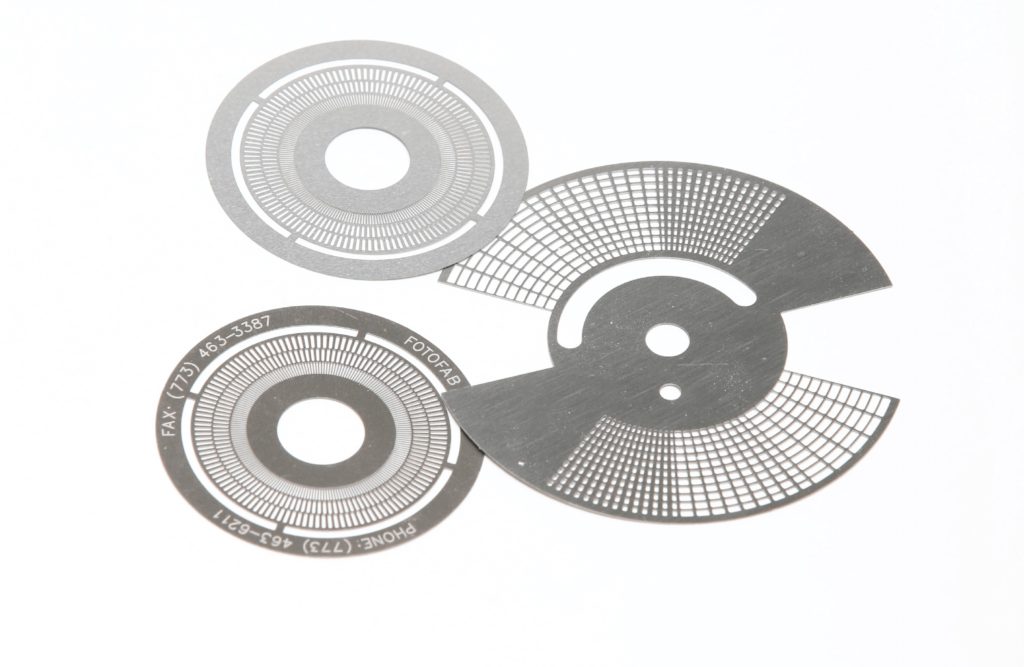
At Fotofab, we manufacture ultra-precise photochemically etched optical encoder discs and wheels engineered for micron-level and sub-micron pattern accuracy. Our process produces burr-free, high-resolution encoding components with exceptional pattern fidelity, enabling reliable motion tracking and feedback in applications where precision, repeatability, and optical signal integrity are essential.
Whether you’re designing an advanced guidance system, a robotics platform, a precision measurement instrument, or a next-generation automation system, we deliver precision optical encoding components engineered to meet the most demanding requirements.
How Optical Encoder Discs Work
Optical Encoders and Motion Feedback Systems
An optical encoder is a sensing device used to monitor movement, position, and rotational performance within a mechanical system. At the center of the assembly is an etched encoder disc or wheel mounted to a motor shaft or rotating assembly.
As the disc rotates, a light source shines through precisely patterned openings while sensors detect interruptions in the light path. These interruptions create electrical signals that are interpreted by the controller.
The resulting output enables the system to:
- Measure rotational position
- Detect movement direction
- Track speed and acceleration
- Monitor distance traveled
- Provide feedback for closed-loop motion control
A typical optical rotary encoder generates a series of square waves as the patterned disc passes between the light source and sensor array. The quality of those signals depends directly on the accuracy of the etched pattern.
Some systems use an incremental rotary encoder design that tracks movement relative to a reference point, while others utilize optical absolute encoders or an absolute rotary encoder architecture that provides a unique code for every position throughout one revolution.
Regardless of architecture, encoder performance begins with pattern precision.
Why Precision Matters in Optical Encoders
Micron-Level Accuracy Drives System Performance
Encoder discs are precision components by design. The geometry of every slot, aperture, and track directly affects signal quality.
Small deviations can create:
- Inaccurate position feedback
- Signal jitter
- Resolution loss
- Timing inconsistencies
- Reduced system reliability
As resolution requirements increase, pattern tolerances become even more critical.
A high-precision encoder may contain hundreds or thousands of features around a single circumference. Even minor variations between features can impact the ability of the system to create clean, repeatable signals.
Edge Quality and Signal Integrity
Many traditional manufacturing methods struggle to maintain clean feature edges at extremely small scales.
Mechanical processes can introduce:
- Burr formation
- Heat distortion
- Material stress
- Feature deformation
These imperfections affect how sensors detect light transitions and can reduce signal quality.
Photochemical etching eliminates these issues by producing burr-free edges and stress-free geometries that preserve optical clarity and signal integrity.
Resolution, Repeatability, and Speed
Modern motion systems frequently operate at high rotational speeds while maintaining demanding accuracy requirements.
Whether the application involves a shaft encoder in an aerospace actuator or wheel encoders in a robotics platform, encoder performance must remain consistent as speed increases.
Reliable pattern reproduction helps ensure stable operation throughout the life of the device.
Benefits of Photochemical Etching for Optical Encoders
Sub-Micron Pattern Control
The Fotofab photochemical etching process enables exceptionally fine feature definition and repeatable pattern reproduction.
This capability allows engineers to develop high-density encoder patterns that support advanced resolution requirements without sacrificing manufacturability.
Burr-Free and Stress-Free Manufacturing
Unlike machining, stamping, or laser processing, photochemical etching removes material chemically rather than mechanically.
This produces:
- Burr-free feature edges
- No heat-affected zones
- No mechanical distortion
- Improved optical performance
These advantages are particularly important for optical rotary encoder applications where edge quality directly impacts signal accuracy.
Repeatable Production Performance
A major challenge in encoder manufacturing is maintaining consistency across production runs.
Photochemical etching provides highly repeatable feature reproduction, ensuring every disc delivers the same optical performance characteristics as the original prototype.
Complex Geometries Without Tooling Constraints
Traditional fabrication methods often struggle with intricate encoding patterns.
Because photochemical machining uses digital artwork rather than hard tooling, complex geometries can be produced efficiently and modified quickly during development.
Ideal for Thin Metal Encoder Components
Encoder discs frequently require thin, lightweight materials that maintain dimensional stability.
Photochemical etching excels at producing thin metal components with precise feature control while preserving material integrity.
Learn more about Fotofab’s precision chemical etching process.
Optical Encoders Applications
Aerospace & Defense
Aerospace and defense systems require motion feedback components that operate reliably in harsh environments where failure is not an option.
Applications include:
- Guidance and navigation systems
- Flight control systems
- Precision positioning assemblies
- Radar and surveillance platforms
- Aerospace instrumentation
These applications depend on accurate motion feedback and reliable absolute position measurement under demanding operating conditions.
See how we service the Aerospace industry.
Robotics & Automation
Advanced robotics platforms rely on encoder feedback to maintain positioning accuracy and motion control.
Applications include:
- Industrial robotics
- Automated assembly systems
- Precision actuators
- Collaborative robots
- Automated inspection equipment
Encoder discs help robotic systems measure movement, detect position changes, and maintain repeatable operation.
See how we service the Robotics & Automation industry.
Optical & Instrumentation Systems
Precision optical instruments depend on highly accurate encoding systems.
Applications include:
- Measurement devices
- Scientific instrumentation
- Optical positioning systems
- Analytical equipment
- Calibration platforms
These systems require clean, consistent signals to support accurate measurement functions.
See how we service the Photonics industry.
Industrial Systems
Industrial motion control systems utilize encoder technology across a wide range of equipment.
Applications include:
- Machine tools
- Positioning systems
- Automated manufacturing equipment
- Packaging systems
- High-speed rotational assemblies
Compared with magnetic encoders and other feedback technologies, optical encoding systems often offer higher resolution and greater accuracy.
See how we service the Industrial sector.
Materials and Design Considerations for Optical Encoders
Material Selection
Material choice affects both optical and mechanical performance.
Common materials include:
Other types include:
The ideal material depends on environmental exposure, rotational requirements, and optical performance goals.
Thickness vs Resolution
Thinner materials often enable higher pattern density and finer feature control.
However, thickness must be balanced against mechanical stability and rotational performance requirements.
Surface Finish Requirements
Surface finish can influence sensor performance and light transmission characteristics.
Fotofab works with customers to optimize material selection and finishing requirements for each application.
High-Speed Rotational Stability
As rotational speed increases, disc stability becomes increasingly important.
Designs must account for:
- Rotational forces
- Dynamic balance
- Feature placement
- Structural integrity
Pattern Density and Feature Resolution
Every encoder system has practical limits based on material thickness, feature size, and manufacturing capability.
Early engineering collaboration helps ensure designs achieve the desired resolution without compromising manufacturability.
Fotofab Manufacturing Capability
Precision Chemical Etching for Optical Encoders
Fotofab’s core capability is precision photochemical etching.
Our process enables:
- Sub-micron pattern fidelity
- Burr-free edge formation
- High precision feature control
- Exceptional dimensional consistency
- Repeatable optical performance
This capability supports mission-critical applications where encoder accuracy directly impacts system performance.
Rapid Prototyping and Production Scalability
Engineering teams often need to test multiple designs before finalizing a production configuration.
Fotofab supports rapid prototyping with turnaround times of approximately one week, allowing teams to test, validate, and refine designs quickly.
Because no hard tooling is required, design changes can be implemented rapidly without costly manufacturing delays.
Learn more about our Rapid Prototyping.
Seamless Transition to Production
Many encoder suppliers struggle to scale prototypes into production while maintaining quality.
Fotofab’s manufacturing process is designed to maintain consistency from prototype quantities through full-scale production volumes.
Customers benefit from:
- Faster development cycles
- Reduced manufacturing risk
- Consistent quality
- Reliable supply chain support
Production Repeatability
Motion control systems depend on consistency.
Our process controls ensure encoder discs maintain repeatable feature geometry and optical performance throughout production, helping customers build reliable systems with confidence.
Engineering Resources
Need more detailed specifications?
Download our Design Guides for Photochemical Machining to discover more about:
- Material options
- Thickness capabilities
- Feature size guidelines
- Tolerance ranges
- Design recommendations
- Manufacturing capabilities
We also have a range of videos you can use as part of your plan.
Experience the Power of Precision for Custom Optical Encoders
When encoder accuracy directly impacts system performance, manufacturing precision matters.
Fotofab produces micron-level optical encoder discs and wheels engineered for demanding aerospace, defense, robotics, instrumentation, and industrial applications.
Whether you’re developing a new motion control system, refining an existing design, or preparing to scale production, our engineering team can help evaluate requirements and recommend the optimal manufacturing approach.
Send a drawing or tell us what you need, and we’ll send a quote right away.
Contact us to discuss material selection, feature resolution, tolerance requirements, and production considerations with a Fotofab engineering specialist.
Work with a manufacturing partner that understands the precision requirements behind today’s most advanced optical encoding systems.
Available Metals
Explore Metals We Chemically Etch
Here at Fotofab, we provide photochemical machining (chemical etching, acid etching) services for a wide range of metals.
Fotofab is committed to quality.




Value Added Services for Chemically Etched Parts
Fotofab offers an array of value-added and finishing options to guarantee your project gets closer to the production finish line. While chemical etching is our core capability, we have an extensive list of resources to give you a ready-to-use component, no matter what your requirements, including:
- Forming
- Plating
- Passivation
- Diffusion Bonding
- Electropolishing
- Custom Packaging
- Laser Cutting & More