Precision-Etched Components for Passive Heat Sink Assemblies
Modern electronic devices continue to shrink while power density continues to rise. As components become smaller and performance demands increase, thermal management becomes one of the most critical design challenges engineers face. In compact systems, even minor dimensional inconsistencies can affect contact surfaces, airflow paths, and overall heat-dissipation efficiency.
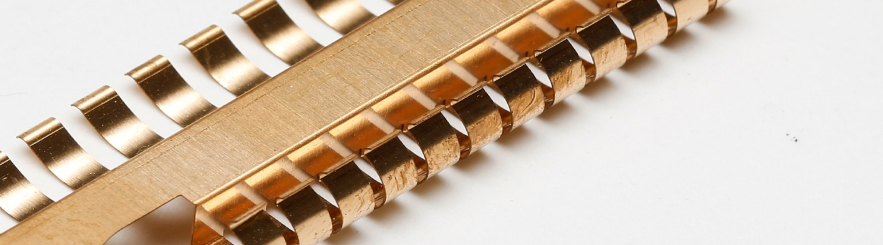
Fotofab produces precision-etched thermal components for passive heat sink assemblies. Using photochemical etching, we achieve tight tolerances, complex geometries, and stable flatness across complex thin-metal designs and materials beyond the normal scope of standard extrusion and skiving, including Kovar, Invar, nickel alloys, copper, and aluminum. For engineers working outside the constraints of standard extruded aluminum profiles, that opens up thermal designs that other manufacturing processes struggle to produce.
The Challenge of Thermal Management in Space-Constrained Electronics
Today’s electronics generate more heat in smaller footprints than ever before. Higher processor speeds, increased power density, and tightly integrated assemblies mean that managing the heat generated by components is no longer optional – it’s essential to ensuring reliability.
In Space-constrained systems:
- Air flow is limited
- Surface area is restricted
- Natural convection is often insufficient
Thermal gradients build quickly. When heat is not effectively dispersed, electronic devices experience reduced efficiency, shortened lifespan, and potential failure. Over time, excessive power dissipation leads to material fatigue, degraded solder joints, and compromised system performance.
Precision becomes essential. The ability to extract heat efficiently from a heat source depends heavily on flatness, dimensional control, and the quality of the interface between mating components. Even slight warping or distortion can create air gaps that reduce thermal conductivity and limit heat transfer.
Discover how Fotofab is delivering precision-etched parts for electronics.
Why Heat Sink Design Depends on Manufacturing Precision
Heat sink design is not just about adding fins or increasing surface area. It is about creating a controlled pathway for conducting heat away from sensitive components.
Key performance factors include:
Flatness and Contact Surface Integrity
Thermal interface material performance depends on intimate contact between surfaces. If a heat sink base is distorted or uneven, thermal conductivity suffers. Precision flatness ensures optimal heat transfer and minimizes resistance at the interface.
Tolerance Control
In compact assemblies, tolerances directly influence assembly stack-up and cooling capacity. Tight tolerance control ensures proper fit with enclosures, thermal interface materials, and mating surfaces
Feature Density and Airflow Optimization
Fine fin spacing and micro-scale features can increase effective surface area while maintaining controlled air flow or fluid flow in advanced cooling configurations.
Burr-free Edges and Dimensional Stability
Mechanical machining and stamping may introduce burrs that disrupt air channels or compromise assembly. Mechanical deformation in thin metal parts affects flatness and contact quality, reducing thermal performance at the interface.
In short, thermal performance starts with dimensional stability.
Precision Photochemical Etching for Heat Sink Components
Fotofab’s photochemical etching process enables engineers to create precision thermal components that standard extrusion and skiving cannot produce.
Our capabilities include:
Thin Metal Profiles
Ideal for low-profile and space-constrained systems where standard extruded profiles are too bulky.
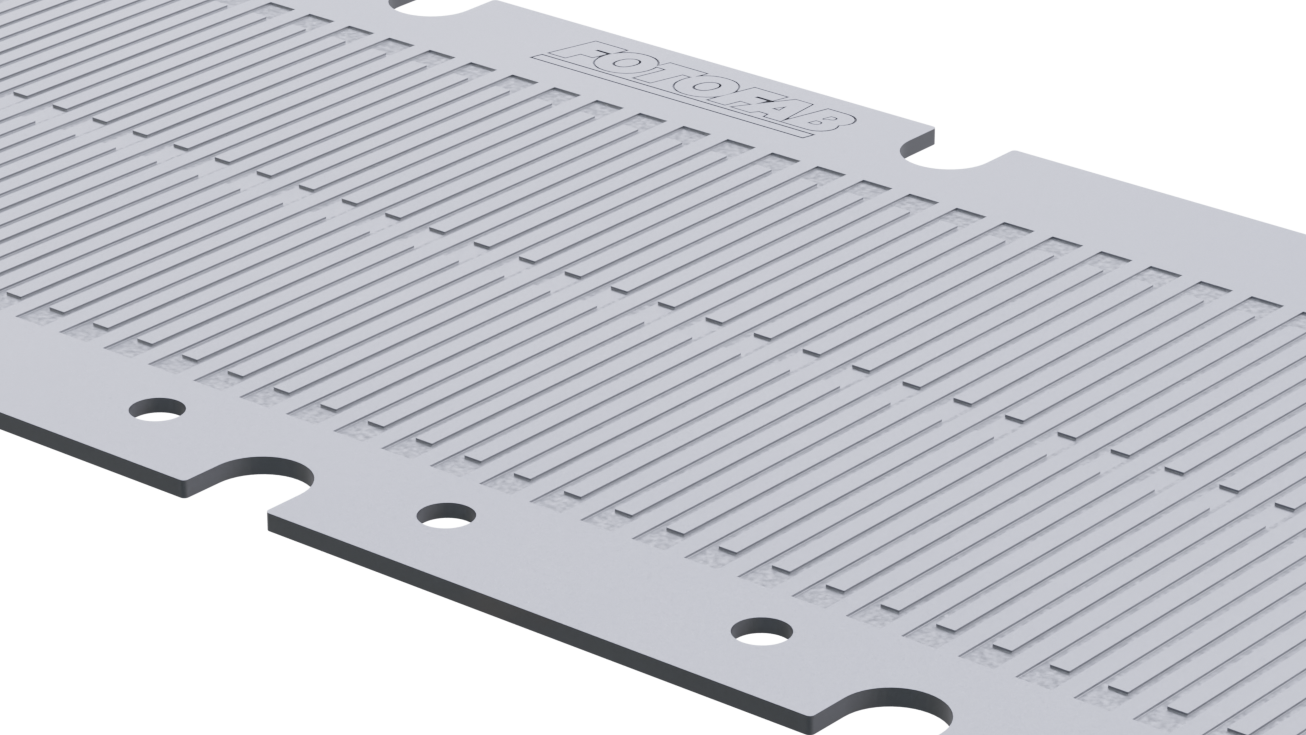
Complex Fin Geometries
Designers can create intricate internal cutouts, optimized airflow channels, and micro-feature arrays that maximize cooling efficiency.
High-Density Micro-Features
Photochemical etching enables precise feature spacing without mechanical stress, allowing increased surface area without adding mass.
Lightweight Designs
Thin aluminum components reduce weight while maintaining structural integrity.
Repeatable Production
Because the process does not rely on cutting tools, there is no hard tooling wear, ensuring consistent repeatability across production volumes.
Formed Metal Profiles
Etched parts can be formed in-house after etching as an added service, extending geometry options beyond flat profiles to include bends, channels, and formed structural features. The burr-free, stress-free benefits of PCE apply to the etched part prior to forming.
Unlike traditional manufacturing methods, photochemical etching allows engineers to design around performance goals rather than manufacturing constraints. The result is a precision-etched passive thermal component that contributes to heat dissipation while maintaining dimensional accuracy.
How PCE compares with other processes
Photochemical etching occupies a specific position in the heat sink manufacturing landscape. It is not the lowest-cost process at volume and does not compete with extrusion or skiving for standard aluminum fin arrays. Where it wins is geometry complexity, material freedom, and design flexibility, particularly at prototype and low-to-mid production volumes.
Precision-etched layers with complex geometries and channels can be diffusion bonded into highly customized passive thermal assemblies that conventional processes would struggle to replicate.
Learn more about Fotofab’s precision photochemical etching process.
Learn more about diffusion bonding.
Photochemical etching
Best suited for complex geometry, non-aluminum materials, low-to-mid volume, and programs where the design is still evolving.
Limitations: Higher per-part cost at high volume. Not suitable for thick-section or fully enclosed 3D geometries. In-house metal forming extends geometry options to include bends, channels, and formed structural features where required.
Extrusion
Best suited for standard aluminum fin arrays at high volume with uniform profiles.
Advantages over PCE: Very low cost per part at volume. Fast throughput. Well-established supply base.
Limitations: Aluminum only, effectively. Uniform profile only. No cutouts, slots, or variable fin spacing. Design changes require a new tooling die.
Skiving
Best suited for high-fin-density aluminum arrays at moderate volume.
Advantages over PCE: Excellent fin density and surface area. No separate tooling die required. Good thermal performance per unit weight.
Limitations: Aluminum only. Straight, parallel fins only. No complex geometry. Fin thickness below a practical minimum becomes unreliable. No exotic material options.
CNC machining
Best suited for thick-section or 3D geometries at low volume where tight tolerances are required.
Advantages over PCE: Full 3D geometry freedom. Works in any machinable material. Very tight tolerances on thick sections.
Limitations: High per-part cost. Slow for complex parts. Burrs require secondary finishing. Poor economics for thin walls.
Stamping and forming
Best suited for simple sheet metal fins at very high volume.
Advantages over PCE: Lowest cost per part at volume. Fast cycle times.
Limitations: Hard tooling required which is expensive and inflexible. Burrs are common. Limited geometry complexity. Design changes are costly.
Metal additive manufacturing / 3D printing
Best suited for highly complex 3D internal structures at very low volume or in research contexts.
Advantages over PCE: Maximum geometry freedom, including internal lattices. No tooling required.
Limitations: Very high cost per part. Surface finish requires post-processing. Slow build times. Overkill for flat or 2D geometries.
Commonly Used Materials for Precision Heat Sink Components
Material selection is critical in thermal management. Fotofab works with a range of high-performance metals to match specific environmental and performance requirements.
Copper Alloys
Copper offers high thermal conductivity and superior heat transfer performance. It is ideal for applications requiring rapid heat extraction from dense components.
Aluminum
Aluminum offers a good balance of low weight, manufacturability, and corrosion resistance in many environments, making it suitable for aerospace and portable electronics applications. Its ability to maintain dimensional stability during manufacturing also enables low-stress components ideal for precision assemblies.
Kovar and Invar
Where thermal expansion matching is critical, such as assemblies bonded to glass, ceramic, or other low-CTE materials, Kovar and Invar provide dimensional stability that aluminum and copper cannot.
Nickel and Specialty Alloys
For harsh environments requiring additional corrosion resistance or structural strength, nickel and other specialty alloys provide stable thermal performance under demanding conditions.
Material choice impacts not only conductivity but also weight, corrosion resistance, and compatibility with plating and surface finishing requirements.
Learn more about the range of metals we etch.
Common Applications for Precision-Etched Thermal Components
Precision-etched thermal components are used in applications where reliability, compact packaging, and design complexity rule out standard manufacturing processes.
Passive heat sink applications include:
- Power electronics
- RF systems
- Aerospace electronics
- Compact embedded systems
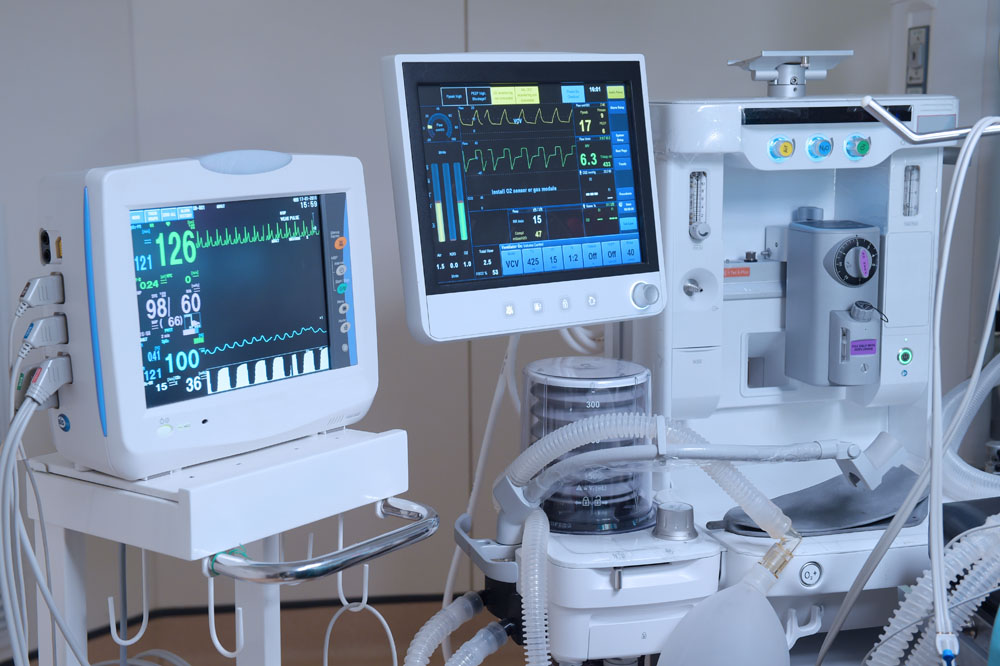
- Medical and diagnostic electronics
- Semiconductor equipment
- Data center electronics
Active liquid-cooled thermal management:
For applications requiring fluid-based cooling, including microchannel cold plates, flow field plates, and multi-layer bonded assemblies, see our heat exchanger components page. For complex multi-layer passive assemblies, see our diffusion bonding and bipolar plate pages.
Benefits of Photochemically Etched Heat Sink Components
Photochemically etched components for passive heat sinks offer distinct advantages in compact, high-performance electronics. As passive thermal devices, heat sinks must be precisely manufactured to transfer heat consistently, particularly in high-power applications where even small dimensional deviations can reduce contact quality and limit thermal performance.
Because photochemical etching dissolves material chemically rather than cutting it, there is no mechanical stress, no heat-affected zone, and no burr formation. The result is a thin, flat, dimensionally stable component with smooth edges and consistent geometry across every part in a production run.
Benefits of this precision process include:
Dimensional Accuracy:
Tight tolerances and stable flatness ensure consistent contact with thermal interface materials, minimizing resistance at the interface and maximizing heat transfer efficiency.
Complex Geometry:
Internal cutouts, variable fin spacing, slots, and micro-scale features are produced in a single process step. No secondary operations required.
Material Freedom:
PCE works in copper, Kovar, Invar, nickel alloys, and other materials beyond the normal scope of standard extrusion and skiving, enabling thermal designs driven by conductivity or CTE requirements rather than process limitations.
No Mechanical Stress:
Chemical dissolution preserves material integrity. Thin walls and fine features hold their geometry without the distortion that machining or stamping introduces.
Scalability:
From first prototype to low-to-mid volume production, the process and tolerances remain identical. No requalification, no process transfer, no surprises.
No Hard Tooling:
Design changes are phototool changes: fast and low cost. There is no die to cut, no tooling investment to protect, and no minimum order quantity tied to tooling amortization.
Burr-free edges:
No mechanical burrs means no secondary deburring, no risk of loose particles in sensitive assemblies, and clean contact surfaces straight off the etching line.
Rapid prototyping:
Multiple design variants can be etched simultaneously on a single sheet at no additional setup cost. New designs turn around in days, not weeks.
How Fotofab Supports Electronics OEMs
Fotofab supports OEMs with:
Rapid Prototyping
Quick iterations allow engineers to validate thermal performance before scaling.
Scalable Production
From prototype to low-to-mid volume production, we maintain dimensional consistency and repeatability.
Tight Tolerance Control
Precision inspection ensures each component meets the specifications for flatness, thickness, and geometry.
Design Optimization
Our team works closely with engineers to ensure designs can be produced within PCE process parameters, providing feedback on tolerances, feature geometry, and material selection before production begins.
Consistent Repeatability
Our photochemical process produces consistent quality across builds, ensuring reliable performance in high-density electronic systems.
Explore additional technical insights in our related blog posts on precision etching for electronics and advanced thermal components.
Thermal Performance Starts with Precision Manufacturing
In modern electronics, the margin for thermal error is shrinking. As systems demand more heat removal in smaller volumes, even minor deviations in flatness or geometry can reduce cooling efficiency and limit reliability.
Precision-etched thermal components provide:
- Tight dimensional control
- Stable metal structure without mechanical stress
- Optimized surface area for dispersing more heat
- Reliable contact with thermal interface materials
- Lightweight, compact configurations
The ability to conduct heat efficiently depends not only on material properties but on dimensional accuracy. A poorly manufactured thermal component can create localized temperature gradients, reducing overall system performance.
Fotofab enables engineers to design unique and customized thermal components that maximize efficiency while maintaining assembly integrity and long-term reliability.
Partner with Fotofab for Precision Thermal Management
If your application demands compact, high-performance heat sink components with tight tolerances and complex geometries, Fotofab is ready to support your custom heat sink component needs.
Our expertise in thin metal manufacturing, photochemical etching, and precision component production covers advanced electronics, aerospace, semiconductor, and medical applications.
Let’s discuss your thermal component requirements and find the right approach for your application.
Request a Quote or Contact Us to Discuss Your Project.
Fotofab is committed to quality.