Precision Metal Forming
Fotofab provides a full range of metal bending and forming services on a rapid delivery basis. Trusted experts in sheet metal fabrication, we manufacture all our own tooling in-house so that we can control quality and lead times. Our system of forming uses simple tooling which can be built quickly and inexpensively.
Rather than making costly progressive dies, tooling is broken up into multiple stations. At each stage, an individual operation is performed, such as a single bend. These stations can be made in parallel, saving time.
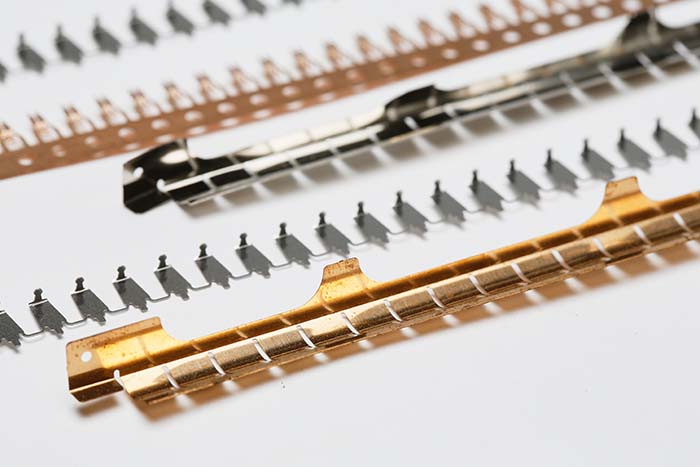

Microblanking & Microforming for Mission-Critical Components
At Fotofab, we deliver precision metal forming at every scale, from micro-size features to complex assemblies, tailored for high-reliability applications in aerospace, medical, electronics, and defense.
Our expertise in microblanking and microforming allows us to produce ultra-precise sheet metal parts with tight tolerances, complex geometries, and burr-free finishes.
What Is Microblanking?
Microblanking is the process of ultra-precise cutting and shaping of thin sheet metal to produce miniature parts with fine features and consistent edge quality. Unlike traditional stamping or laser cutting, microblanking offers clean edges, minimal distortion, and extremely tight tolerances.
Microforming Specifications
- Tolerances: ±0.0005″
- Thickness Range: 0.001″ – 0.010″
- Minimum Feature Size: Down to 0.001″ depending on material
- Edge Quality: Burr-free, smooth, no heat-affected zones
- Materials Supported: Stainless steel, titanium, beryllium copper, nickel alloys, phosphor bronze, and more
Microblanking vs. Other Methods
| Method | Tolerance | Edge Quality | Heat Affected Zone | Setup Cost | Ideal For |
| Microblanking | ±0.0005″ | Burr-free | None | Low | Medical, aerospace, high-precision |
| Micro-stamping | ±0.001″–0.002 | Minor burrs | None | Moderate | Higher-volume parts with lower detail |
| Laser Cutting | ±0.002″–0.005″ | May have slag | Yes | Low | Larger parts, less fine geometry |
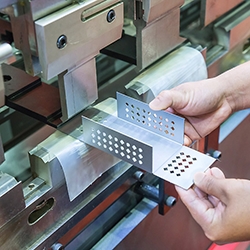
Our Precision Metal Forming Capabilities
Fotofab works with material thicknesses from 0.0001” to 0.125” (0.0025 to 3.175 mm), depending on the features required. Like the chemical etching process, our standard lead time is one week. Expedited lead times are available in as little as one day.
Whether you have a fully formed dimensional drawing or need engineering support, our engineering team can work with you to help design the blanks and tooling required. We are experts in knowing how to etch and bend the parts to their final shape and want to provide feature-complete parts so you can begin using them instantly.
Advantages of Our Precision Sheet Metal Forming Process
- Speed: Parts can be formed in as little as one day
- Precision: Tolerances can be held as tight as +/- 0.001” (0.025mm)
- Cost: Tooling cost is minimal
- Flexibility: Multi-station tooling allows geometries not otherwise achievable with progressive dies
- Reliability: All parts are made to Fotofab’s exacting quality and craftsmanship standards
- Growth: Short prototype runs can smoothly transition to mass production runs
In-House Tooling that Saves Time and Costs
Fotofab stocks pre-built tools for dimpling and simple 90-degree bends, so we can save time on your next project. Precision metal forming methods available:
- Kick Presses, 30+ on-site
- Hydraulic Presses, including a deep draw press that allows the manufacturing of drawn cans
- 4-Slide Machines, which can be used for stamping and forming
- Hand Forming
Etching Experts – The Fotofab Difference
At Fotofab, photochemical etching isn’t an afterthought, it’s our core advantage. Unlike traditional metal forming processes like stamping or machining, etching allows for high-precision features, ultra-fine geometries, and zero-deformation fabrication of thin metal parts.
A key limitation of traditional stamping is the 2.5× thickness rule: it’s nearly impossible to produce holes or features smaller than 2.5 times the material’s thickness. For example, with a 0.010″ sheet, the smallest stamped hole would be 0.025″.
Our etching process breaks through that barrier, routinely delivering features as small as 0.005″ with clean edges and no burrs, ideal for filter screens, mesh structures, microfluidic parts, and more.
It’s important to note that the minimum round hole size we can achieve with etching is also 0.005″, which is the smallest round geometry the process can reliably produce. This level of precision makes etching the clear choice for applications that demand tight tolerances and intricate design flexibility beyond what mechanical processes can offer.
Emerging Applications for Etched Parts
As innovation drives miniaturization across industries, etched components are enabling technologies that stamping or machining can’t cost-effectively support. We’re seeing growing demand from sectors such as:
- Wearable technology – ultra-light, skin-safe components with fine mesh or intricate patterns
- Lab-on-a-chip and diagnostics – micro-scale filters and fluidic channels with clean, precise edges
- Renewable energy – lightweight, corrosion-resistant parts for batteries, fuel cells, and sensors
- Telecom & 5G – complex RF shielding and signal filters where fine features are critical
From prototyping to production, our advanced etching capabilities help you go smaller, cleaner, and faster without compromise.
Fotofab’s Forming Equipment
Kick Presses
Fotofab most often uses kick presses as part of our metal forming process. They are quick to set up and ideal for low-cost tooling. Even when built quickly, our results are precise and repeatable. Unlike other methods used by many prototype shops, our approach does not rely on the manual work of operators, but rather, robust tooling, ensuring consistent results for bent sheet metal components. For projects that require more complex bends or angles, we also utilize press brake forming to meet exact design specifications. This process is ideal for rapid prototype parts where speed and accuracy are essential.
Hydraulic Presses
Hydraulic presses are ideal for thicker metals or parts requiring additional force for bending, drawing, or coining, but they can also be adapted for forming certain thin metal sheets when enhanced precision or strength is needed. These presses are a key part of Fotofab’s manufacturing processes and are commonly used with sheet metal stock that demands tight control over mechanical properties. Fotofab often uses hydraulic presses to create what we call a one-shot tool. Unlike stage tooling, which requires a separate operation for each bend, a one-shot tool performs all operations in a single strike. These tools cost more than stage tooling but can pay for themselves at a lower part cost with adequate volume. The break-even quantity will vary based on the geometry of the part.
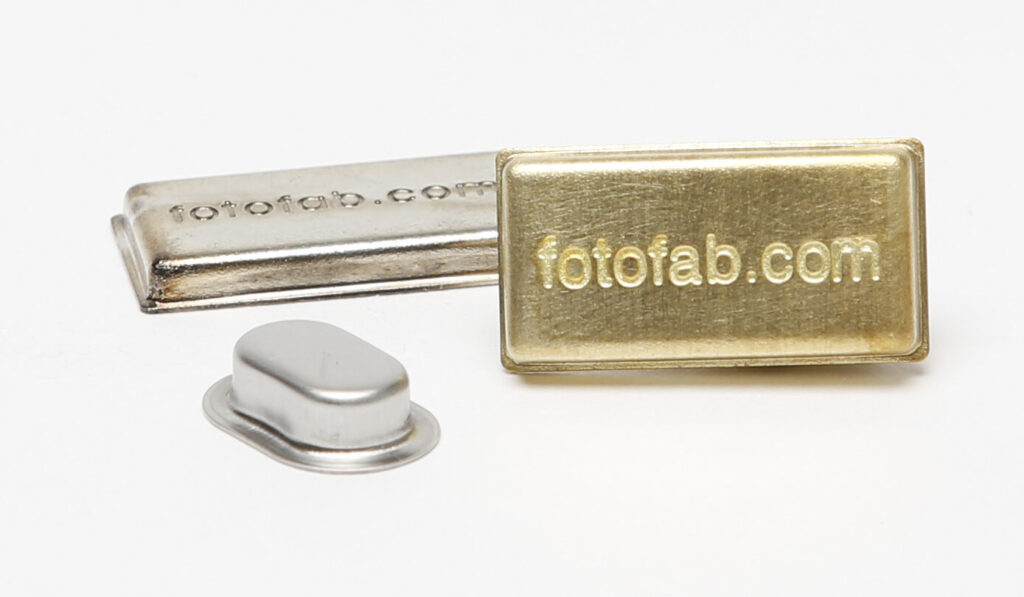
Drawing Cans
Fotofab produces drawn cans in rapid prototype and production quantities using a deep drawing process. A drawn can is a seamless, 5-sided box with rounded corners, made by stretching or “drawing” the middle of a rectangular metal sheet blank. They can be made from material 0.010″ to 0.040” thick with a draw radius of 2.5x thickness and finished with or without a lip along the bottom. They can be very inexpensive and are also ideal for hermetic applications.
4-Slide Machines
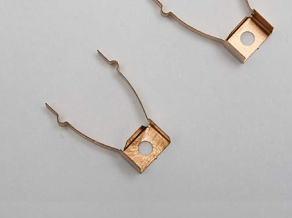
4-Slide Stamping is suitable for smaller parts (0.002-0.32″ thickness, and typically narrower than 2″) with a less complex feature geometry. The machine is a horizontal press with 4 moving tools that strike the metal part from different directions. By working on 4 axes, it is able to be very versatile and usually less expensive to tool than a progressive die.
This is most commonly used for contacts, springs, and small connectors made in a wide variety of metals. Our high-quality standards and craftsmanship remain the same whether the job is a short-run prototype or transitioned to a mass production run.
Hand Forming
For the quickest and least expensive option, Fotofab recommends hand forming. Hand forming is ideal for parts at least 0.008” thick (0.2 mm) with 90° bends and does not require tooling. To facilitate this, we half-etch a channel into the blank, which serves as the inside of the bend and ensures an easy and accurate bend. This method is particularly useful for prototypes where minor imperfections, such as a rough surface, are acceptable, and the emphasis is on achieving the final form quickly and cost-effectively.
4-Slide Stamping
The features of a 4-slide stamping machine combine a unique forming operation that reduces cost, speeds up production, and delivers a better end product, even for those with complex designs
Industries We Serve
Aerospace
Fotofab supports leading aerospace manufacturers with lightweight, high-precision parts for use in satellite systems, avionics, and aerospace sensors. Our AS9100D-certified sheet metal forming processes meet the tight tolerances and quality requirements for modern flight applications.
Medical
Medical innovation demands exacting standards. Our microforming and photochemical etching technologies are ideal for implantable devices, endoscopic instruments, and diagnostic micro tools. We work with biocompatible metals and ensure components meet FDA and ISO 13485 manufacturing needs.
Electronics & Semiconductors
From fine EMI/RFI shielding to intricate micro-connectors, Fotofab produces complex sheet metal parts for high-speed, high-frequency electronics. Our photochemical etching paired with metal forming enables the production of thin, conductive parts with repeatable accuracy, ideal for wearables, sensors, and semiconductors.
Defense & Military
We produce secure enclosures, micro shielding, and sensor hardware for military electronics and aerospace defense platforms. As an ITAR-registered U.S. manufacturer, Fotofab ensures total compliance and confidentiality across all metal forming processes for defense-related contracts.
Why Choose Fotofab for Sheet Metal Forming?
When it comes to precision sheet metal forming, Fotofab combines decades of experience with advanced fabrication processes and expertly engineered forming tools to deliver high-quality components for demanding industries.
- 50+ Years of Experience in photochemical etching and forming
- U.S.-based Manufacturing for controlled, ITAR-compliant production
- In-House Tooling & Prototyping for rapid development
- Expertise with Thin Metals – ideal for forming without distortion
- Scalable Production from prototype to high-volume
Whether you’re designing microformed titanium stents, aerospace-grade brackets, or miniature RF shields, Fotofab delivers the precision, speed, and reliability your product demands.
Committed to Quality
Fotofab maintains strict quality controls with full traceability, backed by industry-recognized certifications that ensure compliance across every project.
We are ISO 9001 certified for quality management and AS9100D certified to meet the rigorous demands of aerospace manufacturing. As an ITAR-registered manufacturer, we adhere to U.S. defense compliance standards, and our processes are RoHS compliant, supporting environmentally responsible production.
Available Metals
Explore Metals We Chemically Etch
Here at Fotofab, we provide photochemical machining (chemical etching, acid etching) services for a wide range of metals and alloys.
Fotofab is committed to quality.