
Microchannel Heat Exchanger Components for Advanced Thermal Management
Modern thermal systems are evolving rapidly. As electronics become more powerful and compact, and as aerospace and industrial systems demand greater performance in smaller footprints, traditional cooling methods are reaching their limits. This shift has led engineers to adopt advanced solutions like microchannel heat exchanger components, a technology that delivers enhanced thermal performance and enables new applications in high-density systems. Photochemical etching makes the precision design and manufacturing of these possible.
These systems rely on precision microchannel metal components to deliver consistent thermal performance in compact environments.
Microchannel heat exchangers play a critical role in applications ranging from high-performance computing to aerospace avionics and industrial systems. But their effectiveness depends on the accuracy of their micro-scale features. Even the smallest deviation in channel geometry can impact heat transfer, system reliability, and long-term performance.
Fotofab is a leader in photochemically etched microchannel components used inside heat exchangers. We don’t build the finished units, but we work with engineers to manufacture the single and bonded plates that go into thermal management systems in electronics, aerospace, and industrial applications. With advanced manufacturing and process expertise, our team helps engineers build compact, high-efficiency thermal solutions that perform reliably in demanding environments.
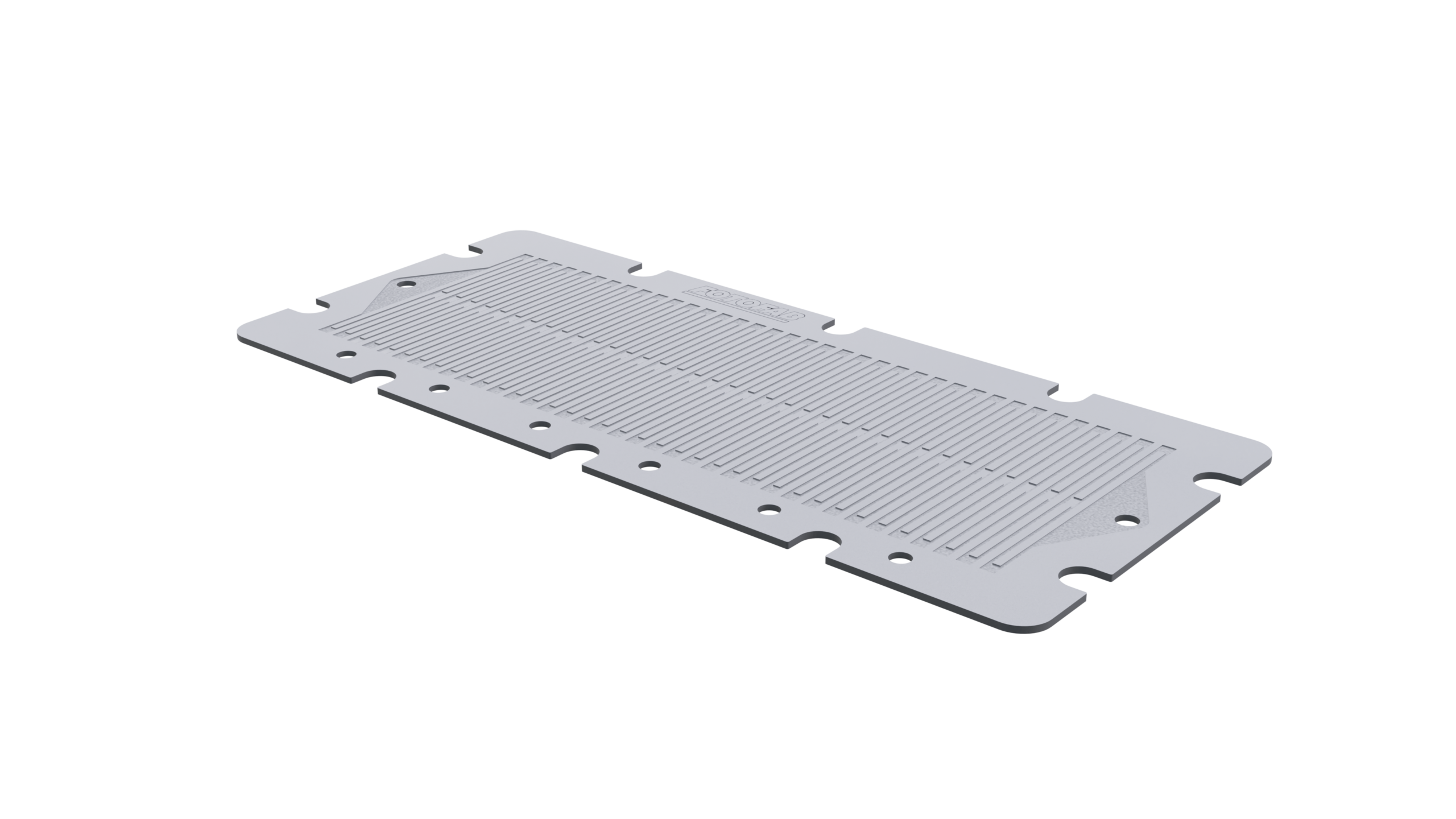
What Are Microchannel Heat Exchangers?
A microchannel heat exchanger is a compact thermal device that uses extremely small flow channels, typically measured in microns, to efficiently transfer heat between fluids or between a fluid and a surface. These channels significantly increase surface area while maintaining a small footprint, enabling high-efficiency cooling in space-constrained systems.
At the core of these systems are precision-etched microchannel plates and flow structures that control fluid flow and thermal exchange.
Microchannel designs are commonly used in:
- Electronics cooling systems
- Aerospace thermal management
- Industrial process equipment
- Heat pump systems
In these applications, fluid, often a liquid coolant or refrigerant, moves through microchannels, allowing the refrigerant to flow through tightly controlled pathways to absorb and dissipate heat efficiently.
Unlike conventional designs, microchannel heat exchangers rely on precise geometry to maximize performance. Channel width, spacing, and surface quality directly affect flow behavior, pressure drop, and overall heat exchanger performance.
Advantages of Microchannel Design for Energy Efficiency
Microchannel heat exchangers offer clear advantages over traditional designs, especially in applications where space, weight, and performance are critical.
Because of these advantages, microchannel heat exchangers are now commonly used in many applications where traditional cooling systems cannot meet performance requirements.
The main advantages include:
Surface Area for Enhanced Heat Transfer
Microchannels dramatically increase surface area relative to volume, improving heat transfer rates and enabling more efficient thermal exchange.
Reduced Weight and Footprint
These systems are typically lighter and more compact than conventional designs, making them ideal for aerospace, electronics, and transportation applications where minimizing mass is essential.
High Heat Flux Capability
Microchannel structures support high heat flux densities, dissipating significant thermal loads from compact, high-performance systems.
Improved Energy Efficiency
By optimizing flow paths and thermal exchange, microchannel designs contribute to overall energy efficiency, reducing system energy consumption and improving operational performance.
These benefits make microchannel designs well-suited for next-generation cooling systems.
The Challenges that Come with Precision Manufacturing
While microchannel designs offer significant benefits, they also introduce a unique set of manufacturing challenges. Achieving consistent performance requires extremely tight tolerances across every feature. Channel dimensions must remain uniform throughout the component, as even slight variations can disrupt fluid flow, increase pressure drop, and reduce overall cooling effectiveness.
Surface quality is equally important. Rough edges, burrs, or inconsistencies can create turbulence within the channels, limiting efficiency and compromising system reliability. In high-performance thermal systems, these small imperfections can have a measurable impact on long-term performance.
Traditional manufacturing methods such as stamping, machining, and laser cutting often introduce mechanical stress, warping or distortion, heat-affected zones, and inconsistent feature geometry. These issues can negatively impact performance and increase the risk of failure in high-reliability applications. In advanced thermal systems, precision is not optional – it’s essential.
Photochemical Etching for Microchannel Heat Exchanger Components
The photochemical etching process for thermal management components enables the production of thin metal microchannel components with consistent precision and repeatability. Unlike traditional methods, it removes material without mechanical force or heat, preserving the metal’s integrity.
Burr-Free, Stress-Free Production
The process produces clean, smooth features without introducing stress or distortion, ensuring optimal fluid flow and consistent thermal performance.
Tight Tolerances and Repeatability
Photochemical etching enables highly accurate and repeatable microchannel geometries, critical for maintaining consistent system performance.
Complex Design Capability
Engineers can design intricate channel patterns, high-aspect-ratio structures, and detailed features without the constraints of tooling.
Fast Prototyping and Scalability
Because the manufacturing process does not require hard tooling, designs can be quickly modified and scaled from prototype to production.
This combination of flexibility and precision makes photochemical etching ideal for advanced heat exchanger technology.
The Importance of Material Options and Thermal Performance
In mechanical and electronic measurement systems, shims and spacers play a deceptively important role. They fine-tune Material selection plays a significant role in the performance of microchannel heat exchangers. Fotofab works with a wide range of metals to meet application-specific requirements.
Copper and Copper Alloys
Copper offers among the highest thermal conductivity of common engineering metals, making it well-suited for high-performance electronics cooling and applications where rapid heat transfer is critical. Copper alloys extend that performance into environments requiring greater mechanical strength or corrosion resistance.
Stainless Steel
Stainless steel offers strong corrosion resistance and mechanical durability at a practical cost, giving it a key role in applications across a range of industries, especially those working in demanding environments.
Aluminum
Aluminum has become the preferred material for a number of key systems due to its lightweight properties and cost advantages.
Specialty Alloys
Materials such as titanium and Kovar serve specialized thermal management requirements.
Titanium offers exceptional corrosion resistance and a high strength-to-weight ratio, making it well-suited for aerospace and chemically aggressive environments. Kovar provides controlled thermal expansion for glass-to-metal sealing and electronics packaging applications.
Each material is selected based on thermal performance, corrosion resistance, mechanical strength, and compatibility with the operating environment.
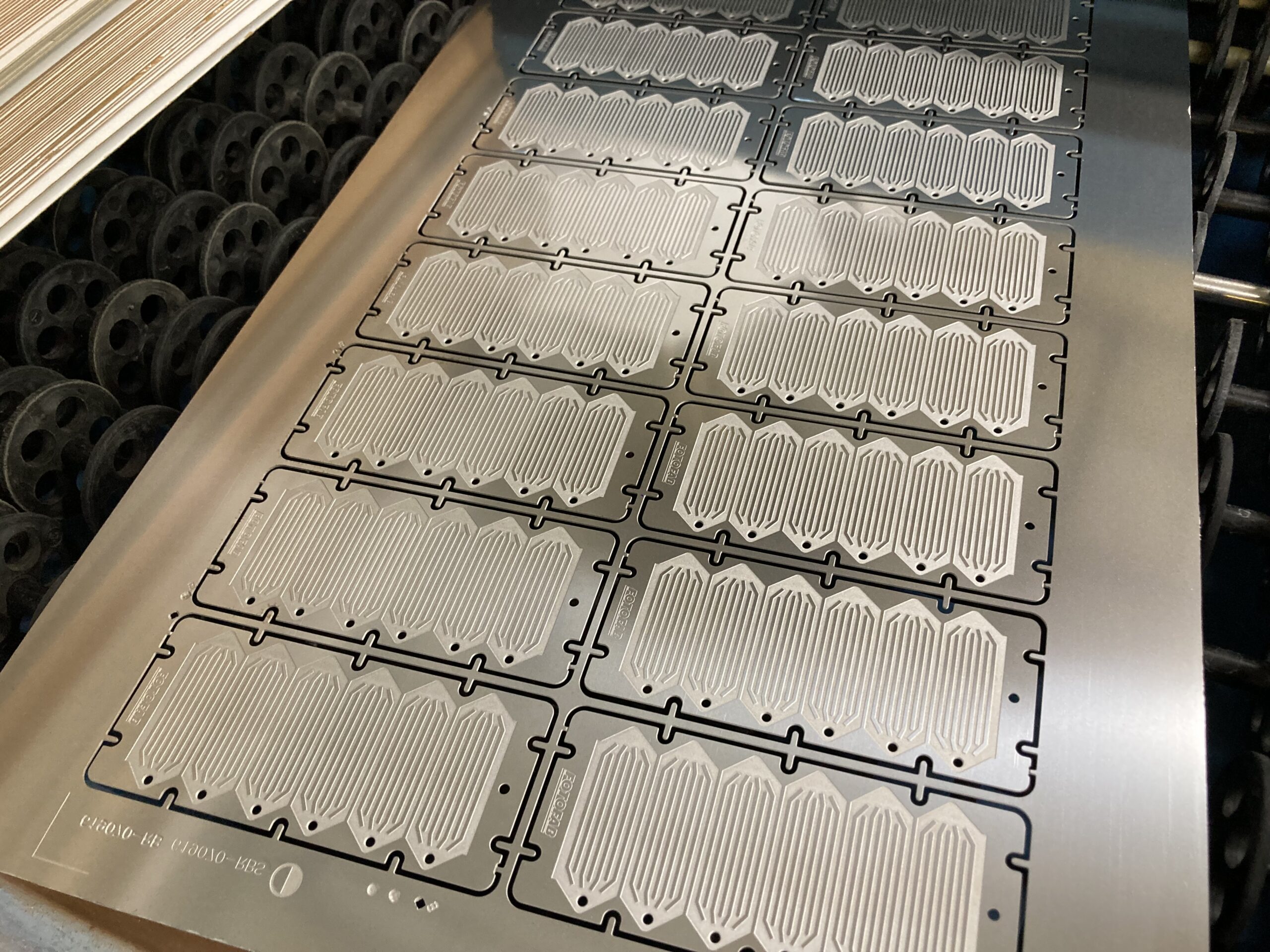
What are the Typical Microchannel Heat Exchanger Components?
Fotofab produces microchannel heat exchanger components engineered for precise fluid control, efficient heat transfer, and compact system integration.
These precision microchannel metal components are designed to maintain tight tolerances and consistent geometry, ensuring reliable performance across demanding thermal applications.
Some of the most common components we produce include:
Finned Plates and Photochemically Etched Fin Structures
Finned plates and photochemically etched fin structures are designed to increase surface area within compact assemblies, enabling more efficient heat transfer. The precision of the etching process ensures uniform fin geometry and spacing, improving airflow or fluid interaction and supporting consistent thermal performance.
Microchannel Arrays and Flow Field Plates
Microchannel arrays and flow field plates control how fluids move through the system, directly influencing heat transfer efficiency and pressure drop. Photochemical etching allows for highly precise, repeatable channel geometries that ensure balanced flow distribution and reliable system performance.
Precision Manifold Plates for Fluid Control
Precision manifold plates manage the distribution and collection of fluids within thermal systems. Accurate channel routing and tight tolerances are critical to maintaining consistent flow rates and preventing pressure imbalances across the system.
Separator Plates for Thermal Systems
Separator plates are used to isolate fluid paths while maintaining efficient thermal exchange between layers. Their flatness, dimensional accuracy, and surface quality are essential for preventing leaks and ensuring reliable performance in stacked or bonded assemblies.
Etched Shim Plates for Thermal Management
Etched shim plates provide precise spacing and alignment within thermal assemblies, ensuring consistent contact between components. Their tight tolerances help maintain uniform thermal interfaces, which are critical for efficient heat transfer and system stability.
Filters and Meshes for Fluid or Particle Separation
Filters and meshes are used to remove contaminants and protect sensitive components within thermal systems. Photochemical etching produces uniform openings and burr-free edges, ensuring consistent filtration performance without disrupting fluid flow.
These components are commonly used in stacked-plate heat exchangers, where layered geometries are combined to create high-performance thermal systems. Fotofab acts as a single-source supplier of both precision-etched single plates and diffusion-bonded assemblies in materials such as copper, stainless steel, titanium, and Kovar. This enables engineers to select the optimal material for performance, corrosion resistance, and application-specific requirements.
View all the products we produce.
Common Applications in Advanced Thermal Management
Microchannel heat exchangers are used across industries where precise thermal control is essential.
High-Performance Computing and Data Centers
Efficient cooling is critical to maintaining system performance and preventing overheating in densely packed electronics.
See how we support the Telecommunications Industry.
Aerospace and Avionics
Thermal systems must perform reliably in extreme conditions, including wide temperature ranges and harsh operating environments.
View our capabilities for aerospace and avionics.
Power Electronics and EV Systems
Battery systems and power conversion equipment require efficient cooling to maintain performance and safety.
See how we’re powering the automotive industry.
Industrial Machinery
Compact, high-efficiency cooling solutions are essential for equipment operating in continuous or high-load environments.
Explore the way we solve critical issues for the industrial sector.
These solutions are widely used as etched microchannel components for electronics cooling, where precision and reliability directly impact system performance.
Why Photochemical Etching Outperforms Other Methods
Photochemical etching provides several advantages over traditional manufacturing techniques, particularly in applications requiring precision and consistency. Unlike conventional methods, it does not introduce heat-affected zones, preserving the material’s properties and avoiding distortion that can impact performance.
Because the process removes material without mechanical force, it eliminates stress on the part, helping maintain flatness and dimensional stability. This is especially important in micro-scale features where even minor deformation can affect fluid flow and overall thermal efficiency.
The photochemical etching process also delivers smooth surface quality, producing smooth channel walls that improve flow characteristics and enhance heat transfer. In addition, it offers greater design freedom, allowing engineers to develop complex microchannel layouts without the constraints of tooling or cutting limitations.
Finally, the process supports faster development cycles through rapid iteration and prototyping, while ensuring high repeatability across production runs. This consistency is critical for maintaining long-term system reliability in demanding thermal management applications.
How Fotofab Supports Engineers and OEMs
Fotofab works closely with engineers and OEMs to deliver precision components that meet exact requirements.
The Fotofab difference comes from the services and expertise we deliver:
Rapid Prototyping and Design Iteration
Quick turnaround times allow engineers to validate designs, iterate on geometry, and refine performance without tooling delays.
Scalable Production
From small pilot runs to full-scale manufacturing, Fotofab supports projects at every stage.
Broad Material Selection
A wide range of materials ensures compatibility with different applications and environments.
Secondary Processes
Fotofab supplies a full range of secondary processes alongside etching, including forming, stamping, plating, heat treatment and diffusion-bonded assembly.
Quality Control
Our strict inspection processes ensure consistency, accuracy, and reliability.
For more information, explore our Heat Exchanger Components Page
Precision Manufacturing Drives Energy Efficiency
Energy Efficiency Starts with Precision
Microchannel heat exchangers deliver exceptional thermal performance, but only when manufactured with precision. The accuracy of channel geometry, surface quality, and material integrity directly influences system efficiency and reliability.
Photochemically etched components provide:
- Improved heat exchanger performance
- Reduced weight and footprint
- Enhanced reliability in demanding environments
- Consistent quality across production
By combining advanced manufacturing with engineering expertise, Fotofab helps customers create thermal solutions that are both highly efficient and reliable.
Partner with Fotofab for Advanced Thermal Management
Fotofab delivers custom heat exchanger components designed for performance, reliability, and scalability.
Whether you are developing next-generation electronics, aerospace systems, or industrial equipment, our team is ready to help you achieve your performance goals.
Contact us to discuss your project or Request a Quote Today
